
20,000 texts take one click. The 1,400 replies take a team. An AI lets one person handle both.
Wholesalers text tens of thousands of investors to sell one house, and then someone has to answer, sort and follow up on every reply. Now an AI answers the usual questions, sorts the buyers by how serious they are and logs every call, so that one person works about 10 times the buyers.
Based on a real project. Names, details and figures changed for privacy and illustration.
The business
You text 20,000 investors about one house. That takes one click.
Then the replies start.
“Stop.” “Who is this?” “How much?” “Wrong number.” “What shape is the roof?”
Somewhere in there: “Is the property vacant? Can we walk it Thursday?”
Every reply needs an answer, a label, a stage and a decision on who gets a follow-up. For 1,400 replies. Today. And again tomorrow.
This is for you if you sell houses off-market and your main way to find buyers is cold text. Or you run any business that texts thousands of people (solar, roofing, insurance, recruiting) and drowns in the replies.
The short version: the texts go out directly instead of through a middleman, about a penny each. An AI reads every reply the moment it lands, answers the usual questions, marks how serious each buyer is and moves them along a board. Calls to the same number are transcribed and scored too. One person now handles tens of thousands of texts.
The company sells houses off-market. Their buyers come from one place: cold text. To find a handful of serious buyers for one house, they text thousands of investors. Sometimes tens of thousands.
The problem
The texting is the easy part. The replies are the job.
Within an hour, hundreds of answers pile into one inbox. “Stop.” “Who is this?” “How much?” “What shape is the roof?” “Can we walk it Thursday?” The basic mass-text tool dumps all of them in one stream.
Picture the job. For every single reply, one person has to:
- read it and work out who is real and who is just curious,
- answer the question (price, roof, access, close date),
- mark the buyers who are interested,
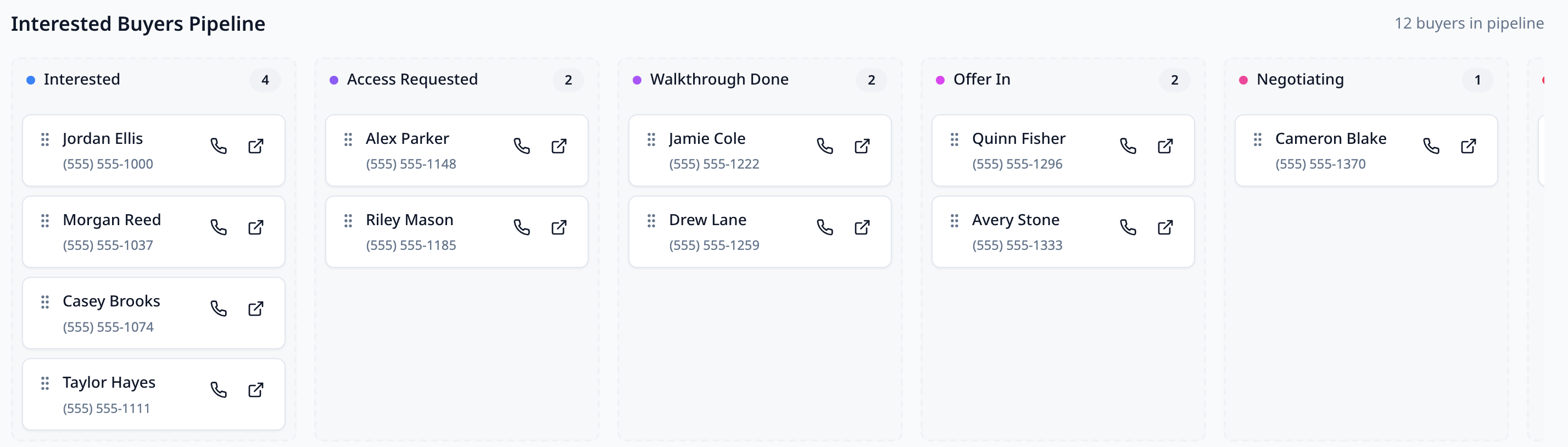
- put each one at the right stage: asked for access, walked the house, offer in, negotiating,
- decide who deserves a follow-up, and remember to do it,
- and keep all of it straight in a spreadsheet.
Now do that accurately, to the best of your ability, for tens of thousands of texts a day. Nobody can. So something slips. A thread gets opened by accident, never answered, and that buyer is lost. A ready buyer does not wait. They buy the next house.
Two more leaks
- Calls. Mass-text tools would not take calls, so every text told buyers to dial a different number. Plenty of buyers tried the main one instead, and it never connected.
- Price. The middleman marked up every single text.
What we built
Four pieces, wrapped around the texting screen the team already lived in
1. The texts go out directly
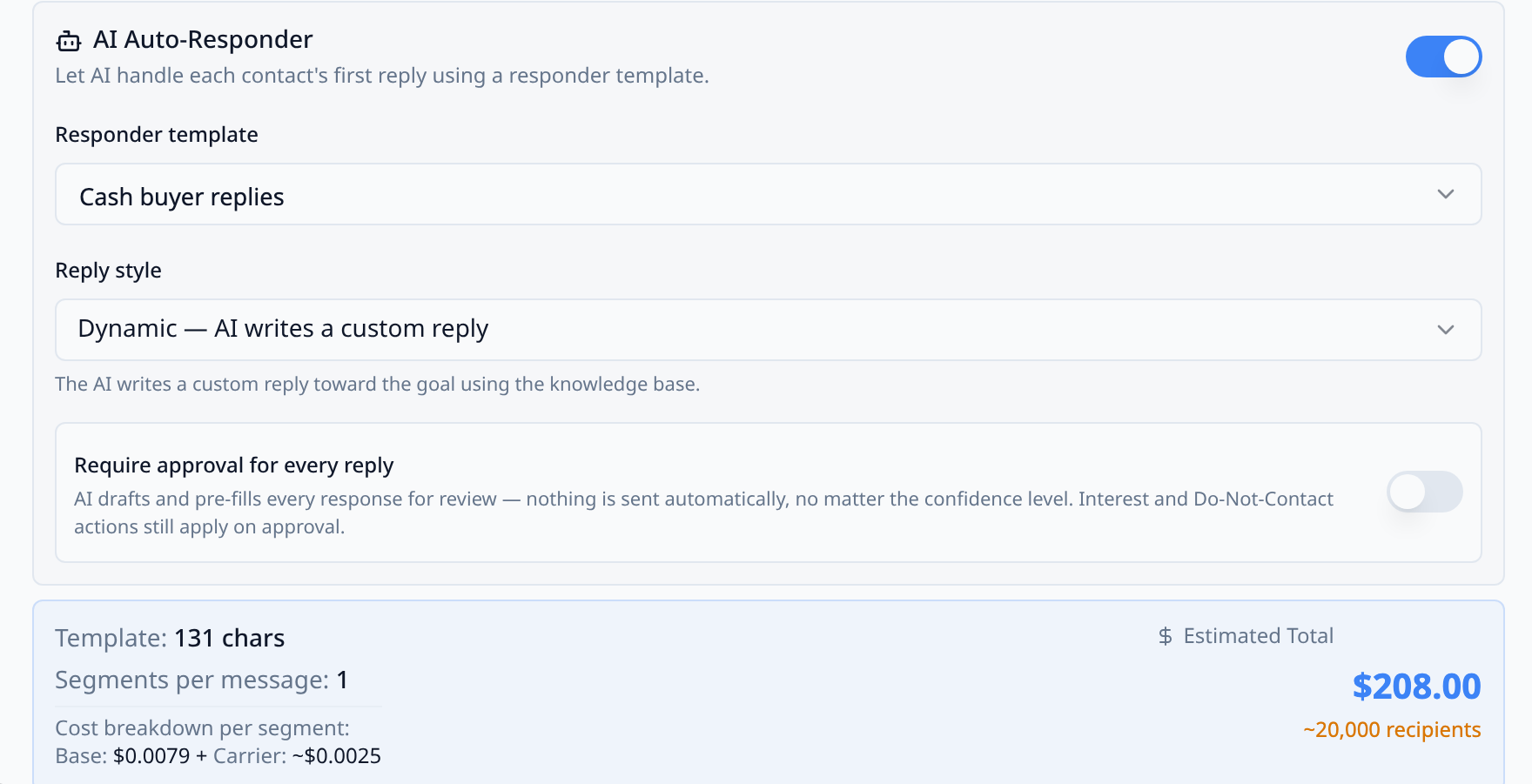
No reseller in the middle. About a penny a text, less than half the old price. A 20,000-text blast costs about $210 instead of about $480.
2. An AI reads every reply the moment it lands
It decides how interested the buyer is, drops them on the board (Interested, Access Requested, Walkthrough Done, Offer In, Negotiating), and answers the usual questions from a fact sheet for that house: asking price, access times, close date. “Yes, interested. What is the asking price?” gets “The asking price is $185,000. Thursday access is available from 2 to 4 PM Eastern. What time works for you?” in seconds, with no one touching it.
3. It only sends when it is sure
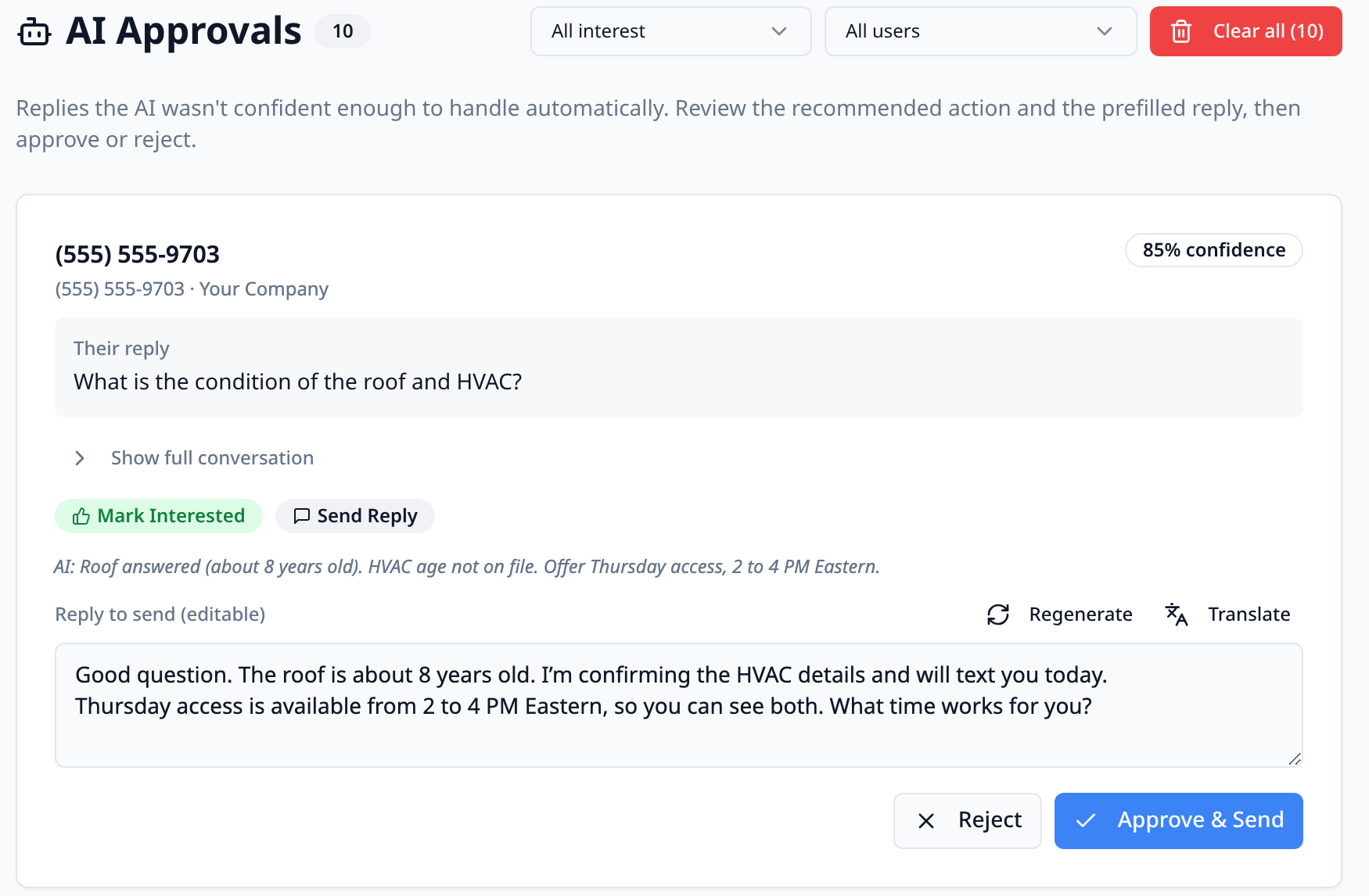
At 90% confidence or higher, the AI replies on its own. Below that, the reply waits in an approval queue with a draft already written. “What is the condition of the roof and HVAC?” is only half in the fact sheet: the roof is, the HVAC is not. So the AI drafts an answer, scores itself at 85% and holds it. A person adds the HVAC detail and sends.

4. Every house has its own phone number
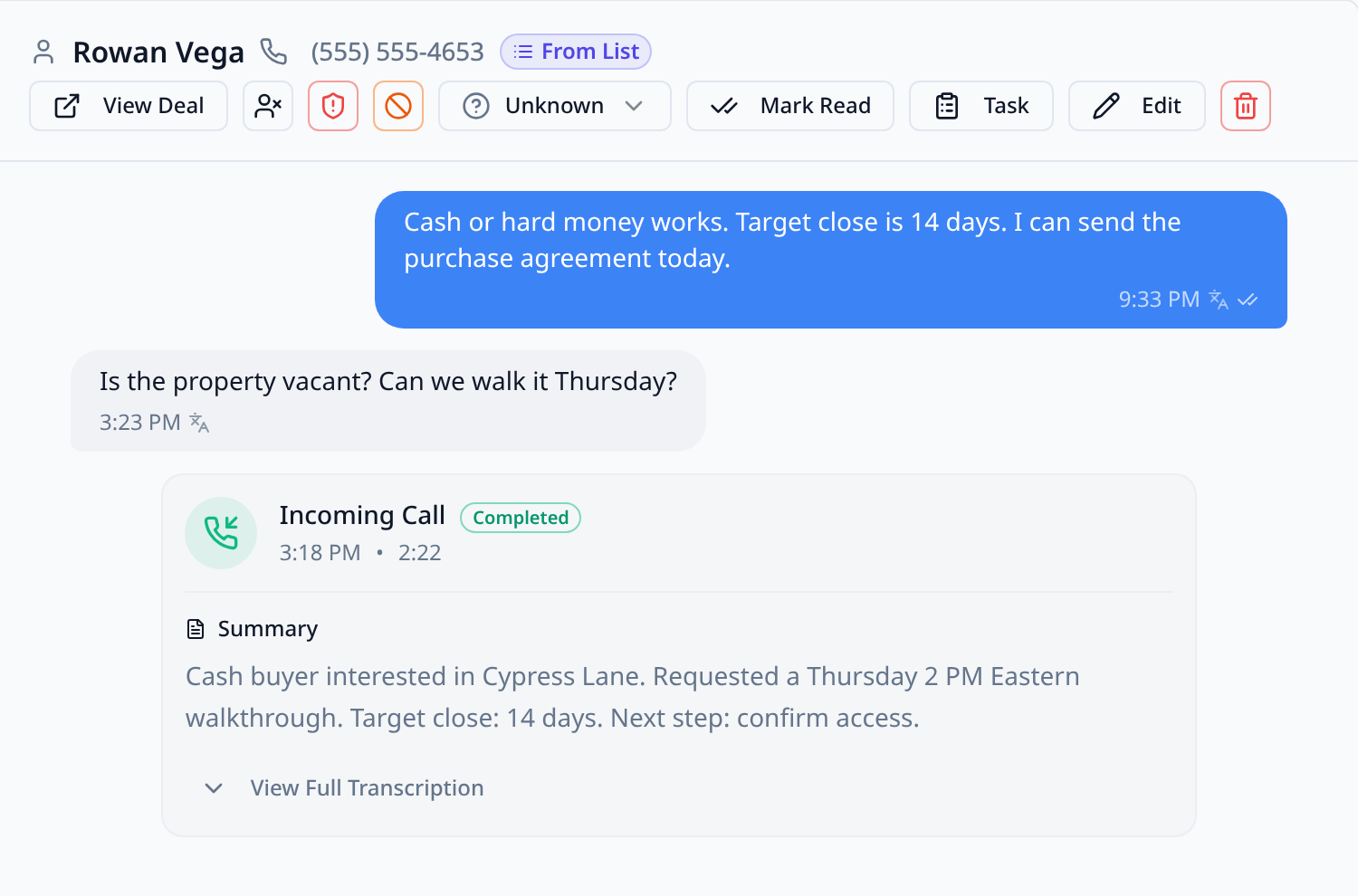
The number in the text rings straight into the system. The call is recorded, transcribed, summarized and scored like a text, and shows up in the same thread: “Cash buyer interested in Cypress Lane. Requested a Thursday 2 PM Eastern walkthrough. Target close: 14 days. Next step: confirm access.”
No more “which house are they calling about?” when ten houses are on the market at once.
The result
10x
the buyers one person can work
| Before | After | |
|---|---|---|
| Cost per text | About 2.4 cents | About 1 cent |
| A 20,000-text blast | About $480 | About $210 |
| Who reads the 1,400 replies | One person, for days | The AI, in seconds. The person sees about 60 buyers |
| Questions like price and access | Typed by hand, one at a time | Answered by the AI at 90% confidence or higher |
| Calls | Lost to the wrong number | Ring the house’s own number, transcribed |
| Tracking | A spreadsheet | A board, by stage |
| Buyers one person can work | 1x | About 10x |
One person. Tens of thousands of texts. Hundreds to thousands of replies, sorted before the coffee gets cold. The buyer who asks to walk the house Thursday gets an answer while they are still holding the phone.
What stays human: the walkthrough, the negotiation and every reply the AI is not sure about.
Steal this
Want to build this yourself? Here’s how it was built, in plain words. It works for any business that sells by text.
| The piece | What it does |
|---|---|
| Twilio | Sends the texts directly and gives each house its own phone number, which replaces the reseller |
| An AI model | Reads each reply, sets the interest level, drafts answers from a per-house fact sheet and scores its own confidence |
| Pyannote | Transcribes each call and labels who said what, so the AI can write the short summary |
| A database and a simple web app | The inbox, the board, the approval queue and the contact lists |
| Claude Code | Builds it and tunes it |
The running cost is about a penny per text plus the AI’s reading. The setup is simpler than it sounds: each house gets a short fact sheet (price, access times, close date, a few details), and you choose how sure the AI must be before it replies on its own.
Prefer not to build it? Have us do it for you.
Is your business in the same spot?
In 30 minutes we'll look at your version of this problem and how an AI system could handle it for you.
Book an AI opportunity audit, $249