
You can only grow as fast as you can onboard. Here, one payment sets up each new client.
For agencies, installers, software and service companies that spend days setting up each new client. In this example, a client fills in a short form and pays. The account sets itself up, and an AI answers their questions.
Based on a real project. The company, names and figures are changed, and the screens show example data.
The short version
86%
In this example, 86% of client questions are answered by the AI with no person.
The business
A salvage yard owner buys a pack of car-seller leads on a sign-up page.
A two-minute form. Then they pay, and go back to work.
By the time they look at the app again, they have their own phone number, an ad campaign and a place to see their leads.
The company’s team set up none of it by hand.
That is the idea: build the setup into the sign-up, so one payment starts the rest.
This is for you if
- You spend days setting up each new client: details, accounts, a phone number, a first campaign.
- New clients keep asking “is it live yet?” and a person has to answer.
- You want more clients without hiring more people for setup and support.
The company in this example sells car-seller leads to salvage yards. A yard signs up online and pays for a pack of leads. The yard here is called Peach State Auto Salvage.
The problem
Each new client starts a to-do list
Signing a client is the fun part. Then:
- Chase the details.
- Set up a phone number.
- Build the first campaign.
- Count what they paid for, and warn them before it runs out.
- Answer “is it live yet?”
Each task is small. Together, they decide how many clients your team can take on in a week.
What we built
What we built: a sign-up that does the setup
Two minutes, then a payment
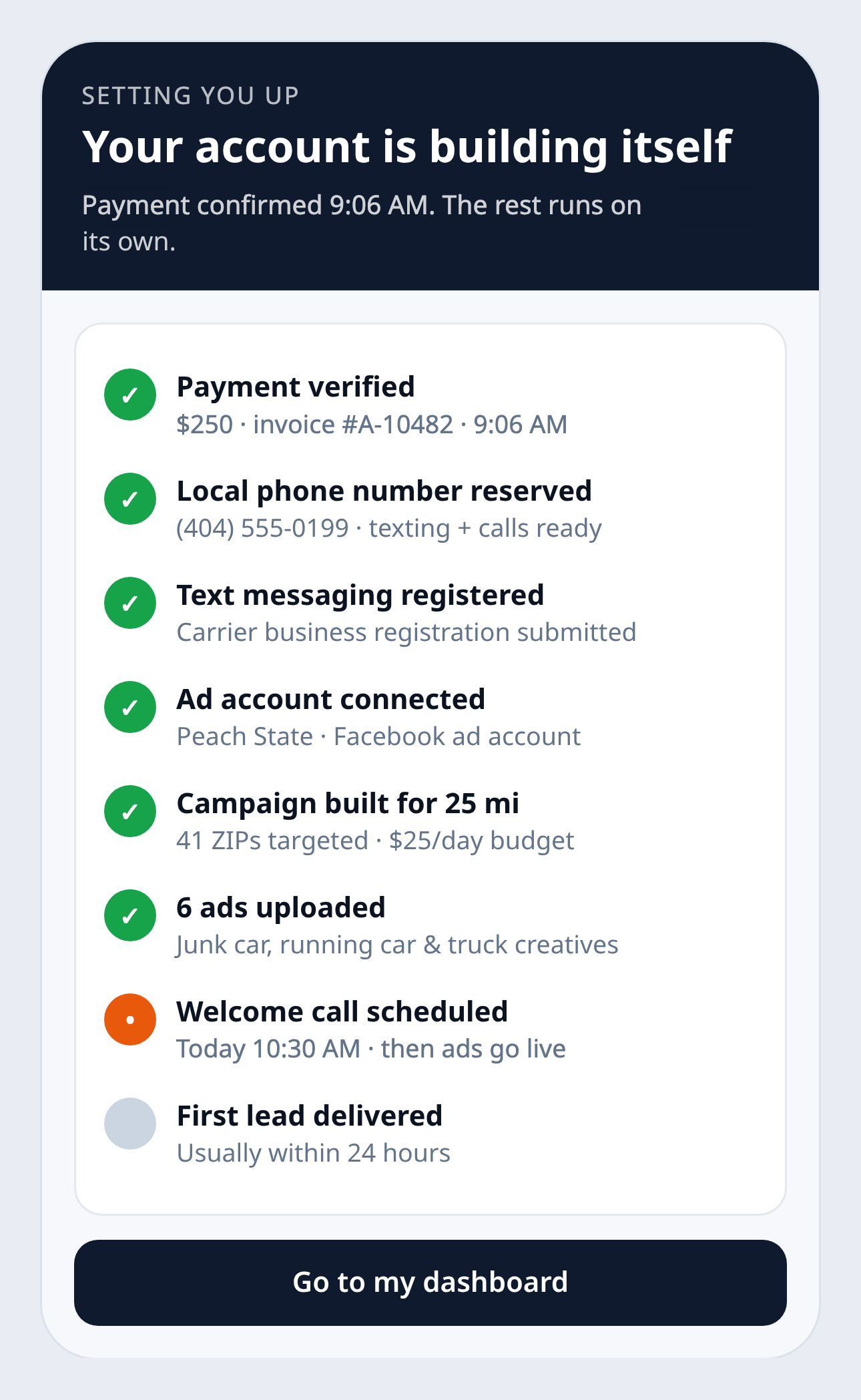
The client fills in a short form: where they buy cars, which cars, how they want leads to reach them. They pay. The account launches only after the payment is verified, then works down the list on its own, like the screen at the top.
A phone line and an ad campaign, built for them
A local phone number is bought in seconds. An ad campaign is built for the yard’s service area, and ads are uploaded. A landing page is set up too, and each lead is tracked. Texting needs a carrier registration, filed for the client. A welcome call is booked, and the first lead usually arrives within a day.
Leads reach them in seconds
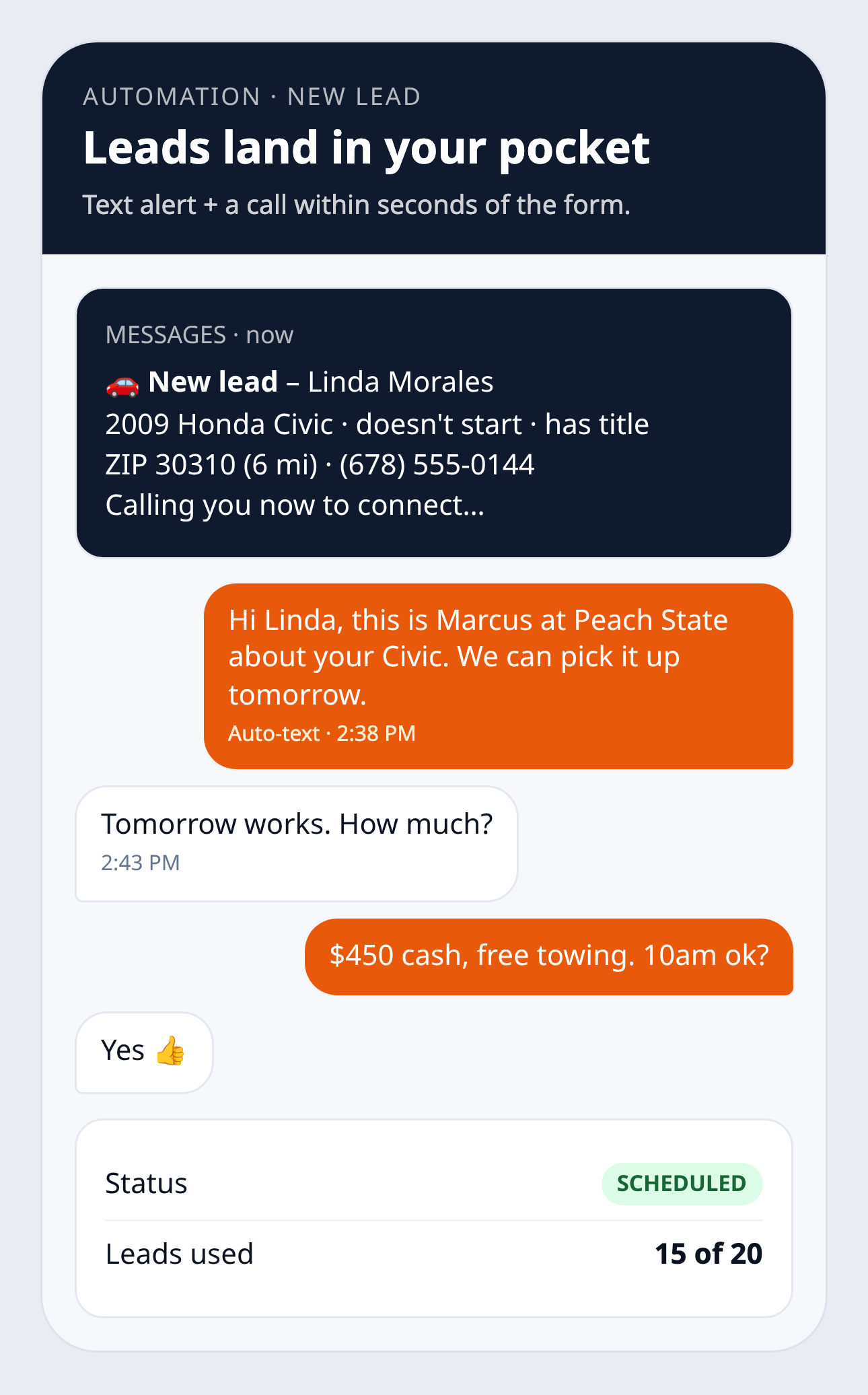
Someone fills in the form to sell their car. The owner gets a text with the details, and their phone rings to connect them to the seller. The seller gets an automatic text, and follow-ups go out for the yard. The owner manages leads in a dashboard set up for them.
It watches the balance
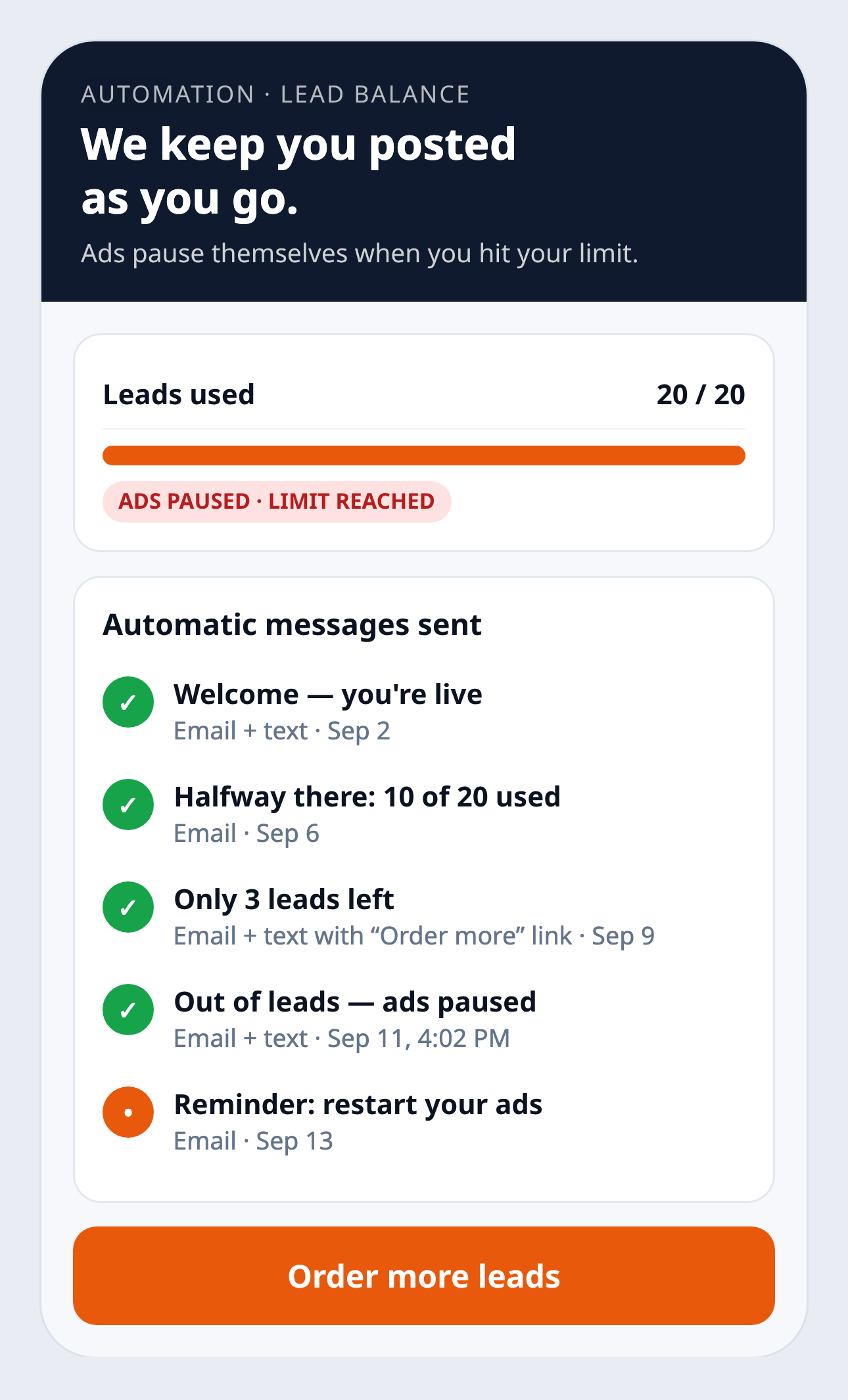
The client paid for a set number of leads, and the system counts each one. It emails at halfway, then emails and texts when only a few are left. When the last one arrives, the ads pause and the client is told. Paying again restarts them.
Bad lead? An AI decides the credit
A client reports a bad lead. An AI checks for signs of a fake. If it looks real, the AI reads the messages and calls between the client and the lead: was it a dud, or a sale that did not close? Then it gives the credit or it does not. No person reviews that decision.
Support that answers itself
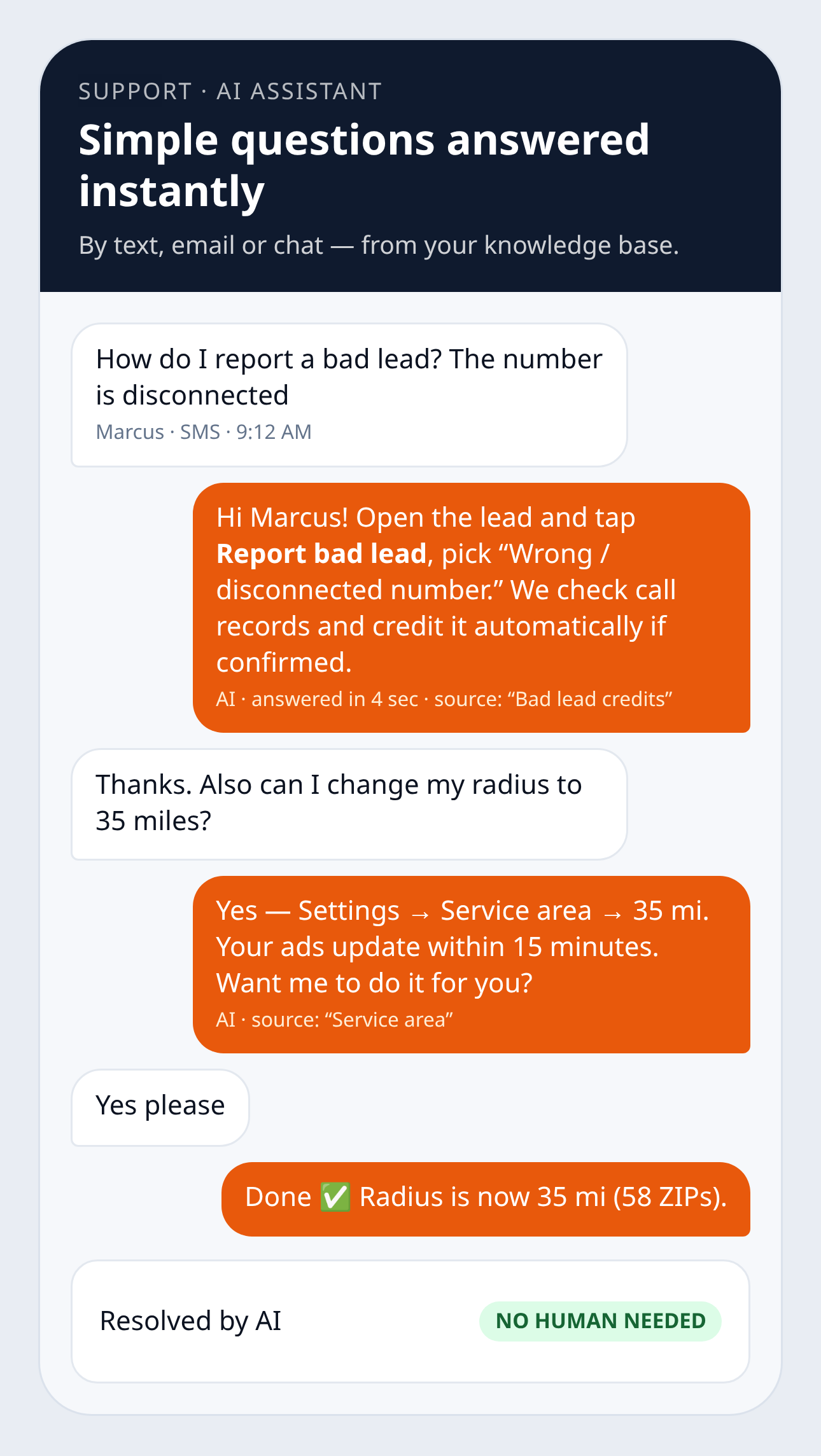
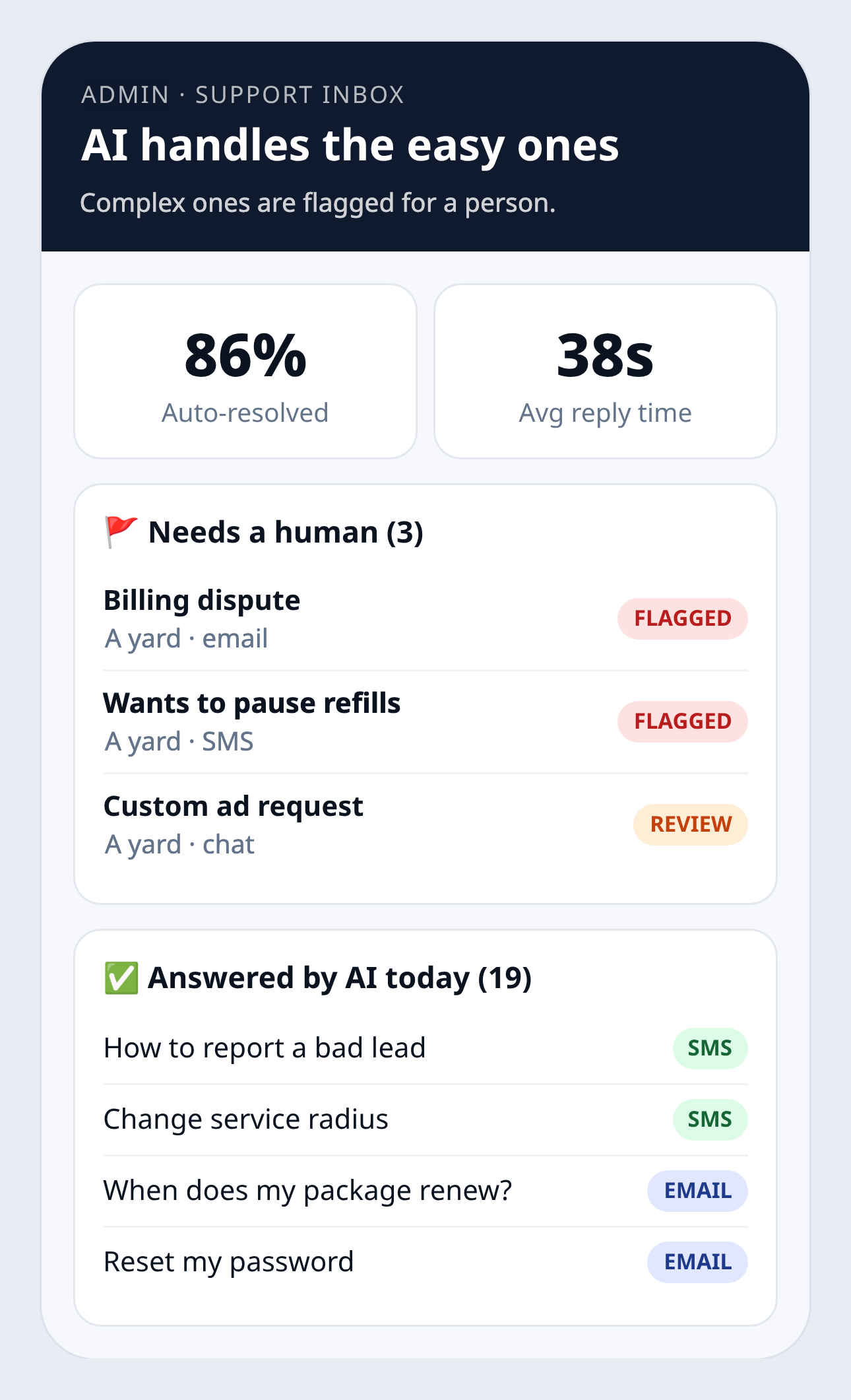
Clients text, email or chat with questions. An AI answers from the company’s knowledge base in seconds, and can make a change, like a wider service area, when the client says yes. If the question goes beyond the knowledge base, it opens a ticket for a person.
Why it works
- The payment is the trigger. The setup starts only after the money is verified, and it is the same for each new client, so it is written down once.
- People handle the exceptions. Billing disputes and custom requests are flagged for a person. The rest is handled.
Earlier days automated what a business does with its own leads and calls, like Day 11 and Day 15. This one automates what happens the moment a client says yes.
The result
86%
In this example, 86% of client questions are answered by the AI with no person.
What changes
86% of client questions are answered by the AI with no person, in this example.
| Before | Now | |
|---|---|---|
| The details | Collected by calls and emails | Collected by a short form |
| The phone line | Set up by a person | Bought and set up in seconds |
| The ad campaign | Built by hand for each client | Built for their area from what they filled in |
| The leads | Sent on and followed up by hand | A text, a call and follow-ups, sent on their own |
| The balance | Someone counts and warns | Warnings go out, and the ads pause at the limit |
| Questions | A person answers each one | The AI answers, and flags what needs a person |
| Bad lead claims | A person reviews each one | An AI checks it and decides on the credit |
What stays human: a person still takes the flagged items, like a billing dispute or a custom request.
Want this for your business? Book a 30-minute consult.
What is the first thing a new client waits on in your business?
Steal this
Want to build this yourself? Here’s how it was built, in plain words. The idea fits businesses where a new client needs accounts, a phone number, a campaign or a login set up before the work can start.
| The piece | What it does |
|---|---|
| Claude Code | Builds the sign-up flow and keeps the pieces connected |
| A sign-up and settings page | Collects the business details, the service area and how the client wants to be reached |
| A payment processor (Stripe or similar) | Charges the card, confirms the payment, handles renewals and reorders. The confirmed payment is what starts the chain |
| A phone and texting service (Twilio) | Buys the local number, forwards calls, receives texts, rings the owner and connects the call to the seller, and sends the automatic texts |
| A carrier registration for business texting | Submitted for each new client so texts can be delivered |
| The ad platform’s campaign tools (Meta, for Facebook ads) | Connect the ad account, build the campaign for the service area, upload the ads, then pause and restart them |
| A landing page template | Generates a page for each client and connects it to their ads, so each lead is tracked |
| A database and a dashboard | Store each client, lead and balance, and show the client their leads |
| A scheduler | Counts the leads, sends the warnings, pauses the ads at the limit and restarts them after a reorder |
| An email service | Sends the welcome, balance and reminder emails |
| An AI model | Answers support questions, checks reported bad leads and decides on the credit |
| A knowledge base | The company’s own answers in plain text: how to report a bad lead, credits, renewals, service areas |
| A support inbox | Where the questions the AI cannot answer are flagged for a person |
Prefer not to build it? Have us do it for you.
Is your business in the same spot?
In 30 minutes we'll look at your version of this problem and how an AI system could handle it for you.
Book an AI opportunity audit, $249