Your competitors changed their prices today. This AI texts you what they are.
A heating oil company used to check competitor websites by hand and change its price too late or too early. Now an AI checks 16 of them twice a day and texts the owner what changed. Any business that sells on price can run the same thing.
Based on a real project. Names, details and figures changed for privacy and illustration.
The business
For: anyone who sells on price against 10 or more competitors and has to reprice often: heating oil and propane dealers, scrap yards, dumpster companies, building suppliers and the like.
The short version: in this example, a heating oil delivery company had to decide, over and over, when to change its price. Oil is one number. The hard part was knowing what every competitor charged. I built an AI that checks 16 competitors twice a day, sorts out who changed and by how much, and texts the owner a plain summary. Now he changes his price on time: not late, not early.
The company delivers heating oil to homes. Customers shop on price, and the price of oil moves, sometimes every day.
The problem
Every time oil moves, the owner has the same question: change my price now, or wait?
What oil costs is the easy part. It's one number. The hard part is everyone else.
In one area he can have 10 or more companies going after the same customers, and a lot of those customers pick on price. To know where he stood, he had to open every competitor's website, find the heating oil price and not forget anyone. Every time. It took so long that sometimes it didn't get done properly, or didn't get done in time.
That left him two ways to be wrong:
- Too late. A competitor drops their price. He doesn't notice. Customers call the cheaper company, and by the time he finds out, the sales are gone.
- Too early. Oil moves, so he changes his price, but his competitors haven't moved yet. He's given away money he didn't have to.
Heating oil is the example here, but the same two mistakes show up anywhere a business sells on price and prices change often.
Late loses the sale. Early loses the margin. The fix isn't a better guess. It's seeing what everyone else is doing, every day, without anyone having to go and look.
What we built
I built an AI agent that watches every competitor for him and tells him what changed. Here's how it works, in five steps.
Step 1: it checks every competitor, twice a day
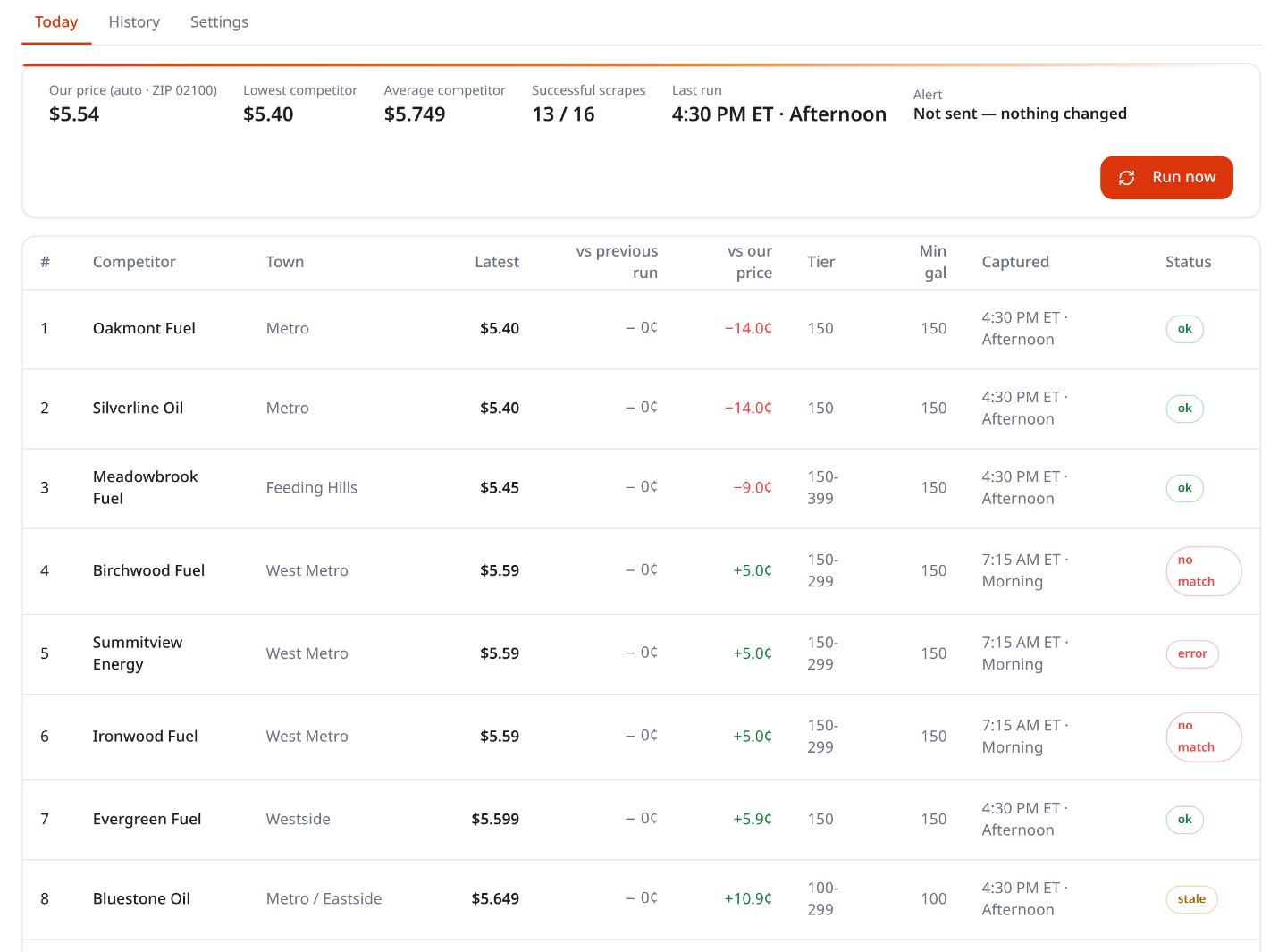
Every morning and every afternoon, the agent visits each competitor's website, finds the heating oil price and saves it. No tabs. No notes. Nobody gets forgotten.
Step 2: it sorts out what changed
For each competitor it works out three things: did the price change since the last check, by how much, and how it compares to his own price. On the board above, two competitors sit 14 cents under him.
Step 3: if a competitor changes their website, it relearns it
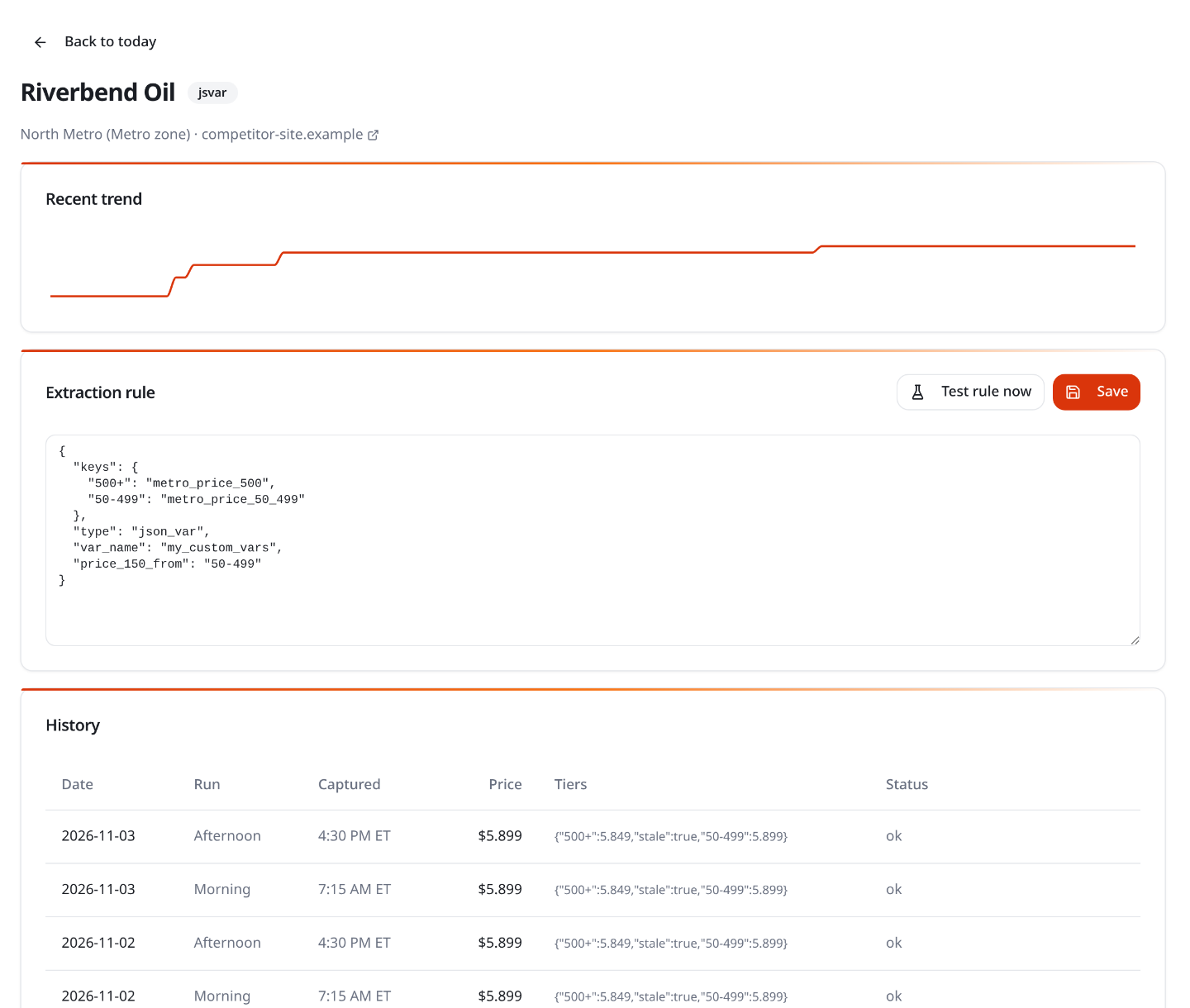
This is where most price trackers die. A competitor redesigns their site, the tracker can't find the price anymore, and it quietly goes stale. Here, the agent notices the price went missing, studies the new page, works out where the price lives and how to reach it, and updates its instructions for that site.
Step 4: it texts the owner what matters
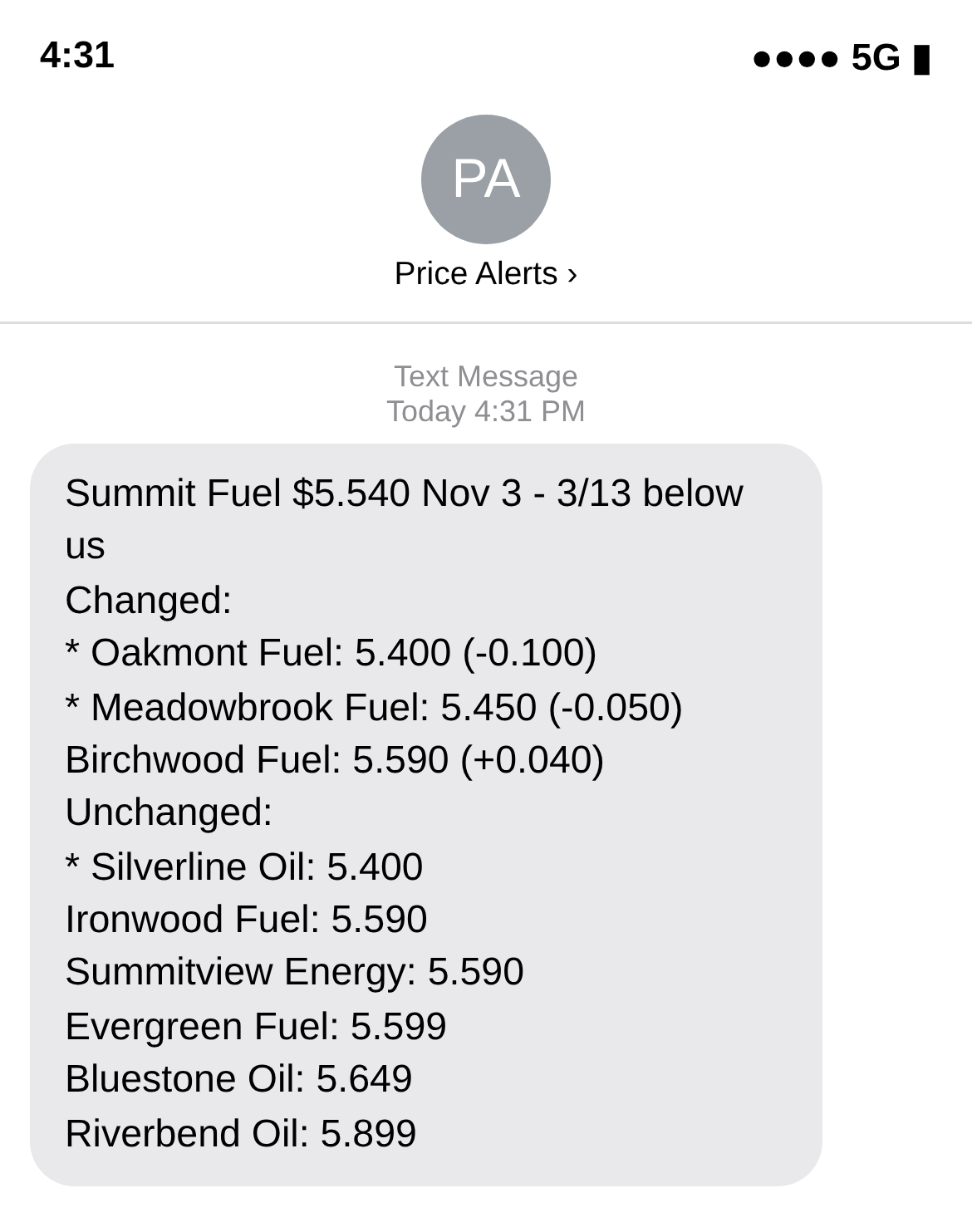
A couple of texts a day, as many as needed. Each one is short and plain: his price, how many competitors are below him, who changed and by how much, and who didn't. The full report goes to his email too.
Step 5: it remembers everything
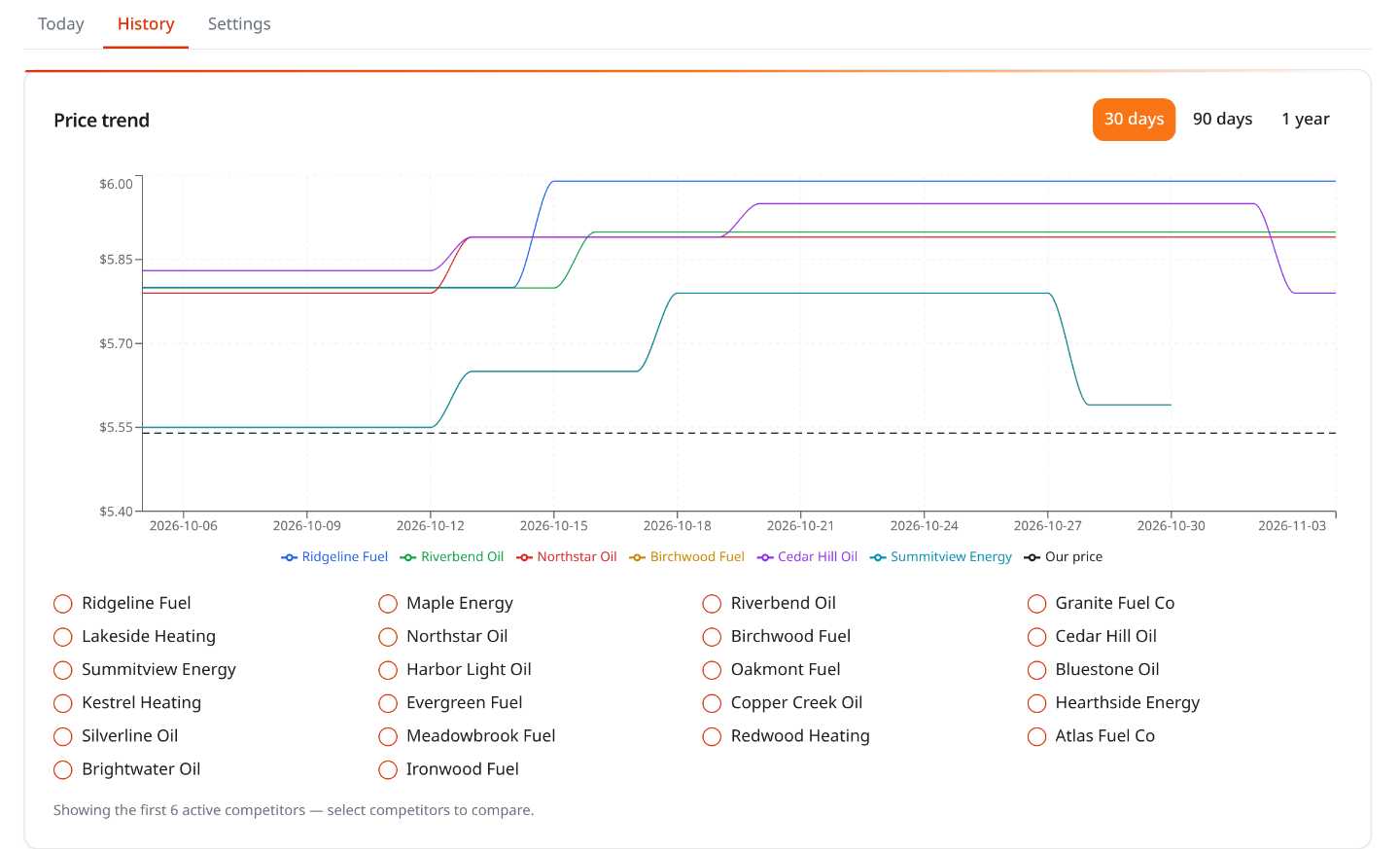
Every price is saved. He can look at any competitor, or several, over 30 days, 90 days or a year, against his own price (the dotted line).
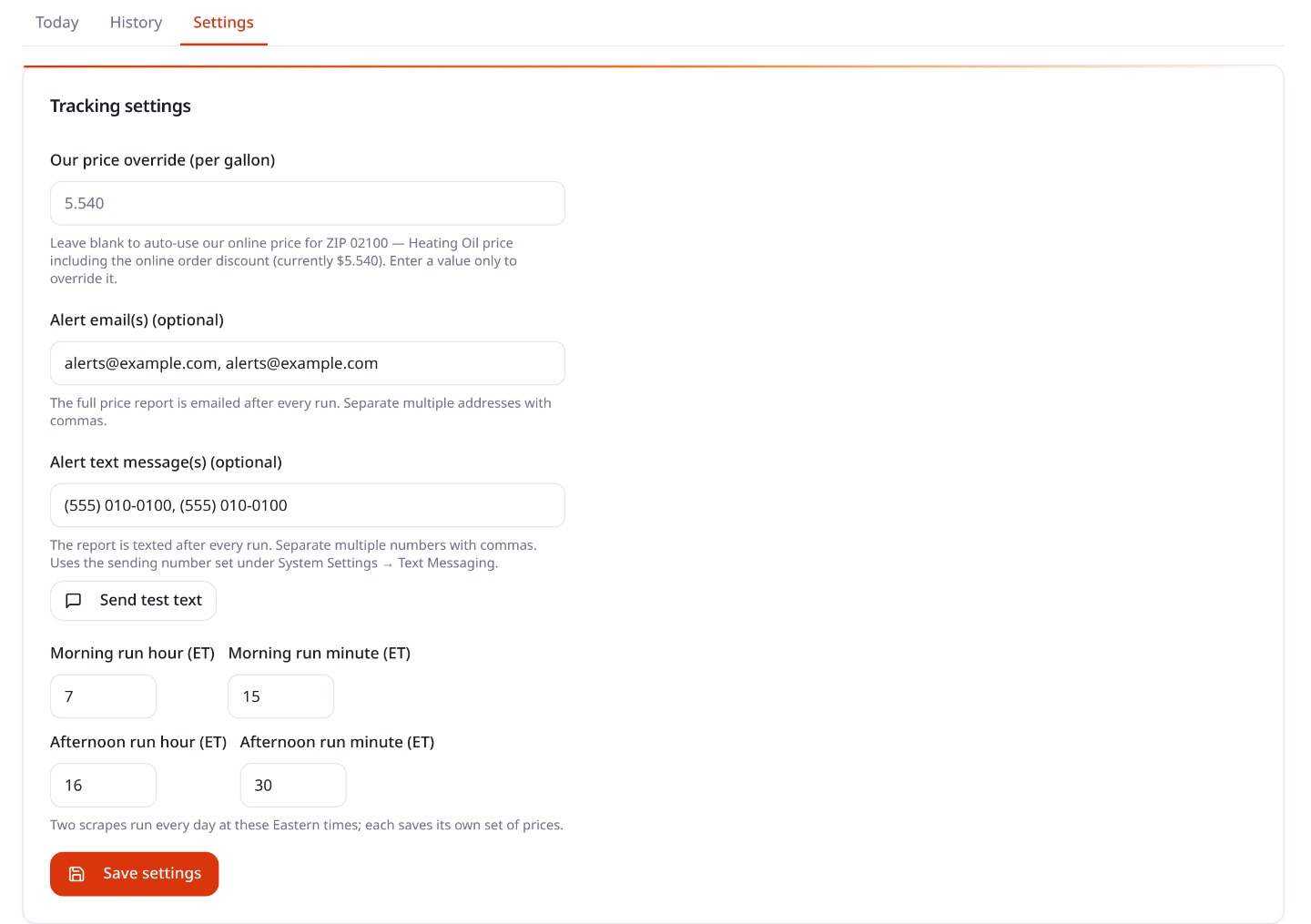
He stays in control of the rest: his own price (or let it read his online price), who gets the texts and emails, and when the two checks run.
Why it works
He sees everyone, not just the few he remembers. Every competitor in the area is on the board, every time.
He hears about a change the same day it happens. The check runs, and a minute later the text arrives. No more finding out a week late from a drop in calls.
It makes the decision easy. A text that says “3 of 13 are below you, and here's who” is a decision. A browser full of 16 tabs is homework.
Nothing breaks quietly. If a site changes or a price can't be found, it's marked and fixed, not shown as if it were fresh.
If you sell on price, ask one question: how do you find out what your competitors charge today? If the answer is “I check when I get a chance,” you're always a little late or a little early.
The result
16 sites to 1 text
competitor websites to check by hand, replaced by one plain text after every check
| Before | After | |
|---|---|---|
| Checking competitors | Open each site by hand, when there was time | All 16, every morning and afternoon, automatically |
| Knowing what changed | A guess, and a few forgotten | A list: who changed, by how much, compared to his price |
| Changing his price | Sometimes late, sometimes too early | On time, with the facts in front of him |
| Sales lost to a late change | A bunch | Far fewer |
| Money lost to an early change | Whenever he guessed wrong | Far fewer |
Late loses the sale. Early loses the margin. Now he finds out in time.
Steal this
Want to build this yourself? Here's how it was built, in plain words.
| The piece | What it does |
|---|---|
| Claude Code | Builds the whole thing: the checker, the price board, the texts and the history |
| A small script for each competitor | Opens their page and reads the price, using a written rule for where it sits |
| An AI model | When a competitor changes their site and a rule stops working, reads the new page, finds the price again and fixes the rule |
| A scheduler | Runs the check at set times, here 7:15 AM and 4:30 PM |
| A database | Keeps every price, so you can see the trend and what changed since last time |
| A text service, like Twilio, and an email service, like Resend | Send the short summary text and the full emailed report |
The part that takes the most work is comparing like with like. Competitors price by delivery size and by town, so the agent has to pick the price that matches a normal order for him, and say so when it can't tell.
Prefer not to build it? Have us do it for you.
Is your business in the same spot?
In 30 minutes we'll look at your version of this problem and how an AI system could handle it for you.
Book a 30-minute consult, $99