This AI agent outworks 20 media buyers. It still asks before it moves a dollar.
A lead company with 400 campaigns gave its ad dashboard an AI agent. It reads every campaign, finds what to raise, cut, pause and bring back, and makes the changes the moment you approve the plan. One person can do a team of 20 media buyers' worth of work.
Based on a real project. Names, details and figures changed for privacy and illustration.
The business
9:05 AM. 400 campaigns are live. You type one sentence: “Which campaigns should I cut today?”
Before your coffee cools, the AI agent has gone through all of them: today, the last two weeks, the last month and their whole life.
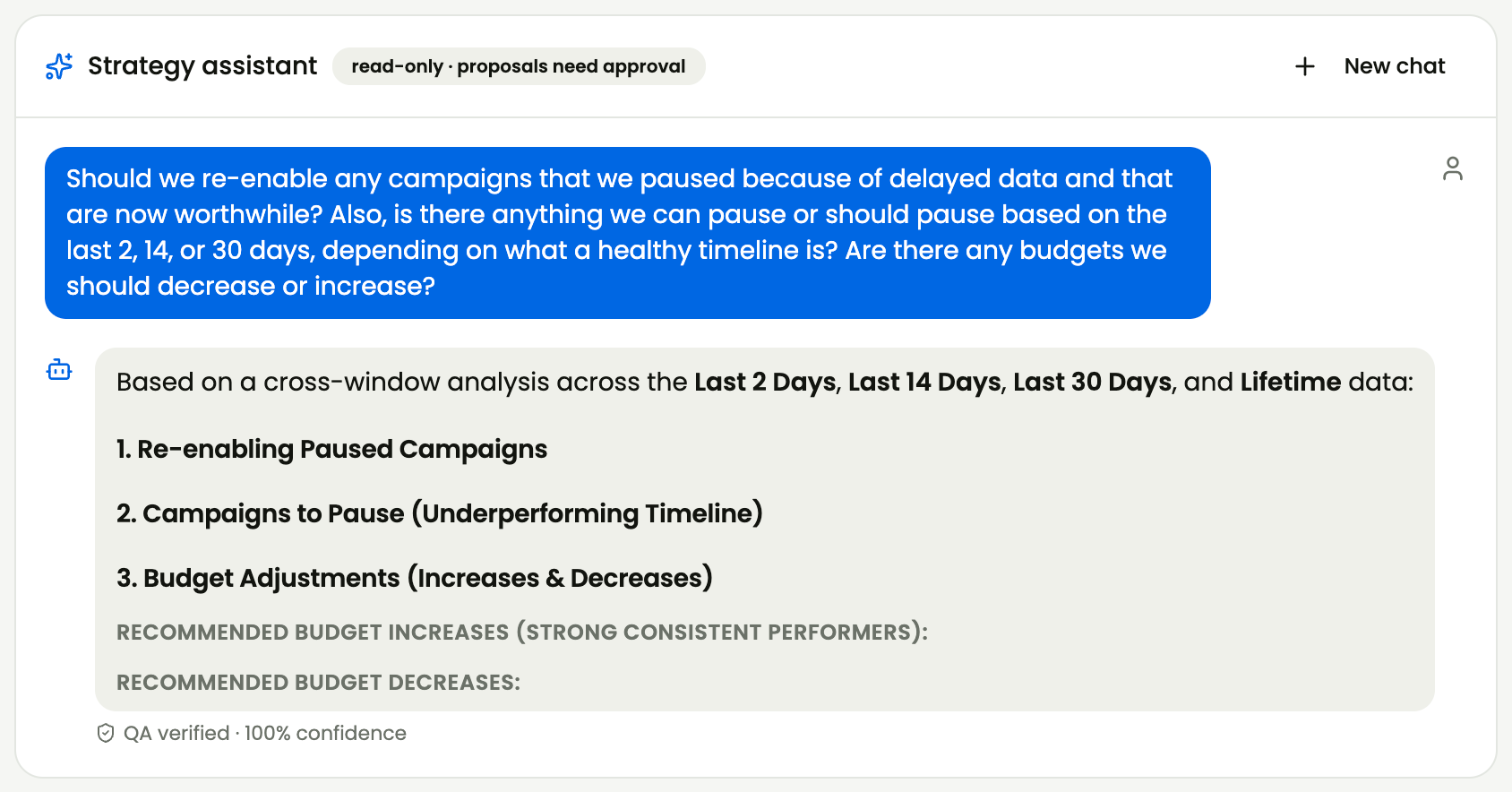
Back comes the plan. 12 to pause. 8 to raise. 5 to bring back. A reason next to every one.
It has not moved a dollar. It is waiting for you. You click once.
This is for you if:
- You run hundreds of campaigns yourself. Your reports tell you what happened, never what to do.
- You pay a team of media buyers or an agency and take their word for what is working.
It works at smaller budgets too.
The example: a lead company runs 400 campaigns on Facebook and sells every lead to a buyer. Day 4 put all of it on one screen. Then it added an AI agent to that screen.
The problem
A campaign nobody checked still spends. One bad one can burn $650 and bring back $130 before lunch.
Now do that for 400 campaigns. Give them to 20 media buyers and each one owns 20, pulls four reports for each (today, two weeks, a month, lifetime), and then everyone sits in a meeting to decide. That is the job, every morning. Skip a step and a campaign quietly loses money for three weeks.
The AI agent does that whole job alone, and it is ready before the meeting would have started.
What we built
So the lead company gave its dashboard an AI agent. You talk to it. It reads the live numbers, writes the plan, and makes the changes once you say yes.
Ask it anything
You talk to it the way you would talk to your best buyer:
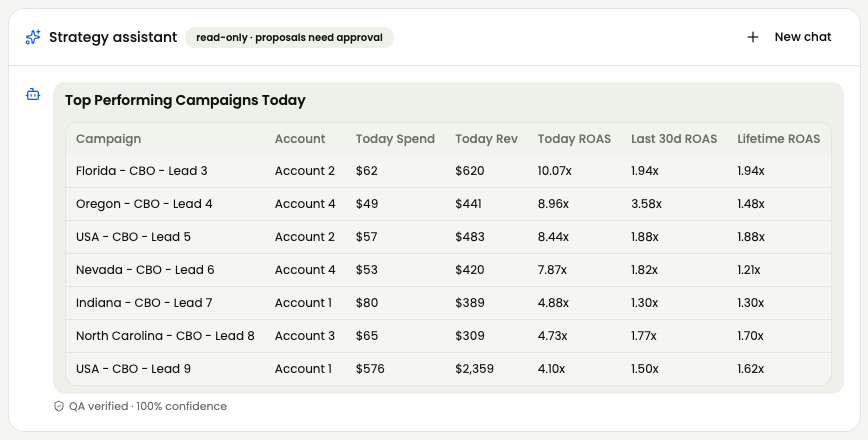
- Which campaigns are doing well today and could take more money?
- Which ones should I turn down?
- Which should I pause for good?
- Which did I pause too early, and should come back?
It goes down to the individual ad when you ask. No filters. No formulas. No spreadsheet. And you can stack questions into one, the way you would in a meeting.
Where it outworks a team of 20
- It judges on more than today. It checks today, the last two weeks, the last month and the whole life of every campaign before it says pause.
- It remembers what you paused. Buyers report revenue late, so a campaign can look dead at noon and earn its money back by Thursday. The agent goes back through everything paused and flags the ones cut too early.
- It shows its reasons. Every call comes with the numbers behind it, so you can see how it got there.
- It checks its own work. After it changes a budget, it asks Facebook whether the change really happened.
Give it a rule. Get a plan.
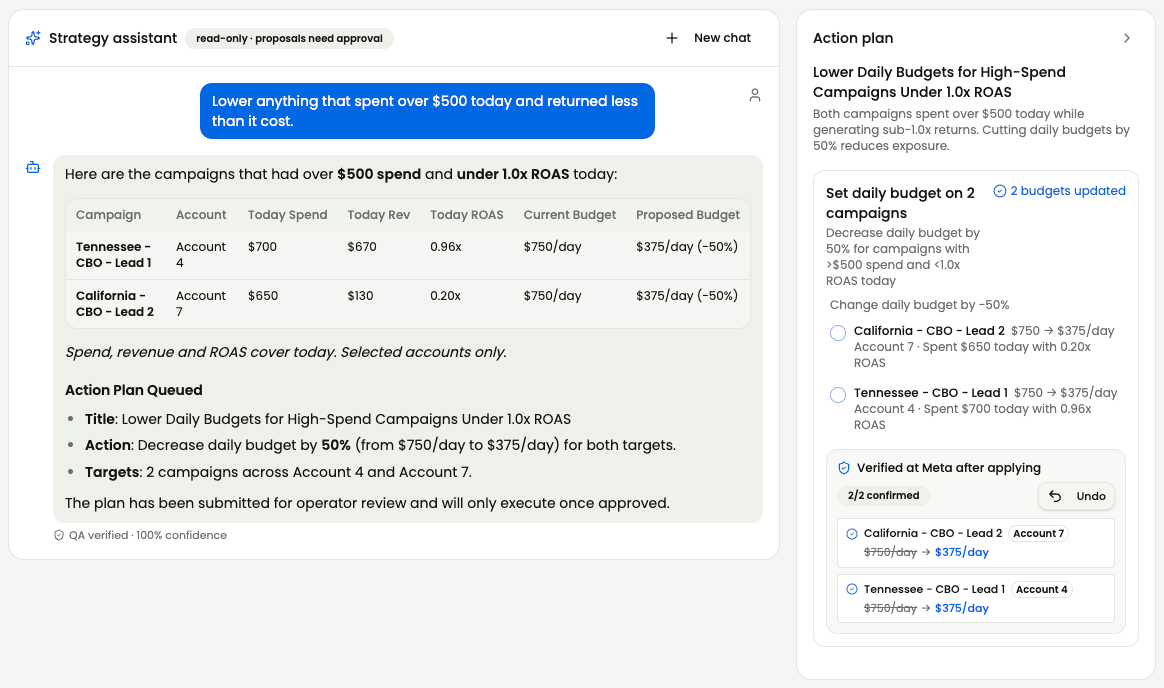
Type a rule the way you would tell a buyer: “Lower anything that spent over $500 today and returned less than it cost.”
It found two campaigns. One spent $650 and brought back $130. The other spent $700 and brought back $670. Both ran on $750-a-day budgets. The plan: cut both to $375 a day. The exact campaigns, the exact new budgets, the reason next to each.
You click once. It makes the changes, then asks Facebook whether each one really happened. 2 of 2 confirmed. Changed your mind? Undo, up to 24 hours later.
When Facebook shuts an account down
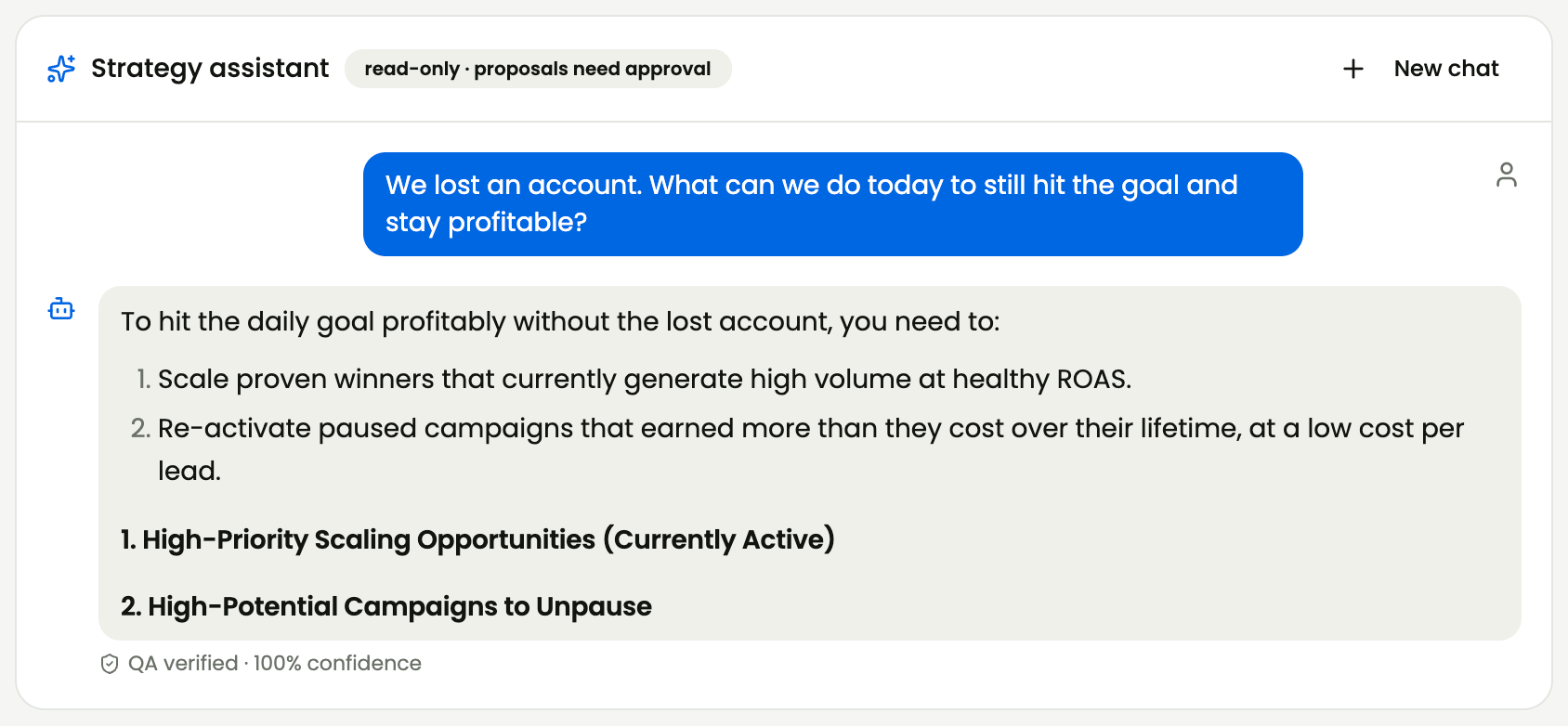
One morning an ad account was disabled overnight, and the day's leads were going to fall short. The owner typed: “We lost an account. What can we do today to still hit the goal and stay profitable?”
It came back with the campaigns that could take more money at a healthy return, plus paused campaigns that had earned more than they cost over their lifetime and deserved a second chance. A plan, not a pep talk. One approval.
It asks before it moves a dollar
This is the part owners care about. The agent proposes. You approve. It only touches the accounts you point it at. Nothing changes until you say yes, and everything it changes can be undone.
Twenty buyers would give you twenty opinions. This one writes down its reasons and waits.
What it changes for you
If you run the spend yourself: you stop being the bottleneck. Reading 400 campaigns stops being a job for a team and becomes one question before breakfast.
If you pay a team or an agency: ask it the same four questions your buyers answer and you will know what you are paying for. The good buyers get faster: they stop pulling reports and start on the parts only people can do.
It does not replace judgment. It does the reading, the comparing and the clicking. You make the call.
The result
400 campaigns, 1 agent
all read, one plan, approved once
| Before | After | |
|---|---|---|
| Reviewing 400 campaigns | A team, four reports each, a meeting | One question |
| Deciding what to cut | Wait for the report, then argue | Ask in plain English |
| Campaigns paused too early | You never find out | The agent flags them |
| Making the changes | Click through campaign by campaign | One approval |
| Knowing it worked | Check later and hope | Facebook is re-checked, 24-hour undo |
The reading, the comparing and the clicking are done for you. The decision stays yours.
Steal this
Want to build this yourself? Here's what it's made of, in plain words.
| The piece | What it does |
|---|---|
| The live dashboard from Day 4 | The agent is only as good as the data under it: ad spend from every platform joined with what each buyer paid, refreshed every 15 minutes |
| An AI model API (Claude or OpenAI) with tool use | The agent's brain. You give it tools to read campaign numbers, live status and schedules, and one tool that can only propose a plan, never apply one |
| The ad platforms' API keys (Facebook, Google, Microsoft, TikTok and others) | Whichever platforms you advertise on. They let the agent read your campaigns and spend, apply an approved plan, then read each campaign back to confirm the change stuck. In this build, the changes are applied on Facebook |
| A plan and approval layer | Proposals wait as a plan. Nothing runs until you click, and every change is logged with a 24-hour undo |
| Hosting | Puts the dashboard and the agent online behind a login, so only you can open them |
| Claude Code | Does the building and the upkeep: the chat, the tools, the approval step and the checks |
The hardest part is teaching it your rules: how long a campaign deserves before it gets cut, how late your revenue arrives, and what it may never touch.
Prefer not to build it? Have us do it for you.
Is your business in the same spot?
In 30 minutes we'll look at your version of this problem and how an AI system could handle it for you.
Book a 30-minute consult, $99