
He said "attorney" on your phone. Your employee said "out of my hands."
A customer threatened the Better Business Bureau, the police and an attorney on a recorded line. The employee who answered said it was out of their hands. Nobody told the owner, because nobody can review the 130 calls his team takes every day. Then an AI started reading every one of them minutes after it ends, for about $14 a month. It builds on Day 1: the $140,000 call nobody returned, and the $20,000 job this AI saved.
Based on a real project. Names, details and figures changed for privacy and illustration.
The business
3:00 PM, Friday. A man calls your office.
He was promised a check and it never came. He asks for the person who owes it. That person isn’t in.
So he says three things: the Better Business Bureau, the police, an attorney.
The employee who picked up says there is nothing they can do. It is out of their hands.
The call ends with a thank you and a you’re welcome.
Everyone on that call knows exactly what was said. You don’t.
This is for you if:
- Employees answer your phones, or drivers and techs talk to customers, and you only hear a call when someone tells you it went wrong.
- A manager “spot-checks” calls and has no idea what the other 99 out of 100 said.
It works for any business that runs on the phone: dumpsters, oil delivery, roofing, repairs, clinics, dealerships, agencies.
The example: a business with drivers on the road, a few people answering one phone line, and no time to listen back. This builds on Day 1, where one $140,000 call went unreturned and the AI saved a $20,000 job. This post is about the other 4,000 calls a month.
The problem
Everyone knew but you
His team takes about 130 calls a day. Nobody reviews them, because nobody can. At about 3 minutes a call, 4,000 calls a month is 200 hours of listening. Pay a person $20 an hour to do it and that is $4,000 a month, and they would still hear that call on Friday.
So the business ran on one rule: if it is bad enough, someone will tell the owner.
How it would have gone
The next Monday, a post on the Better Business Bureau site.
Wednesday, a letter from an attorney.
Friday, 4:45 PM, the owner reads it at his kitchen table. It is the first he has heard of any check.
The fix would have been one check. Now it is a lawyer.
What we built
The version where you hear it first
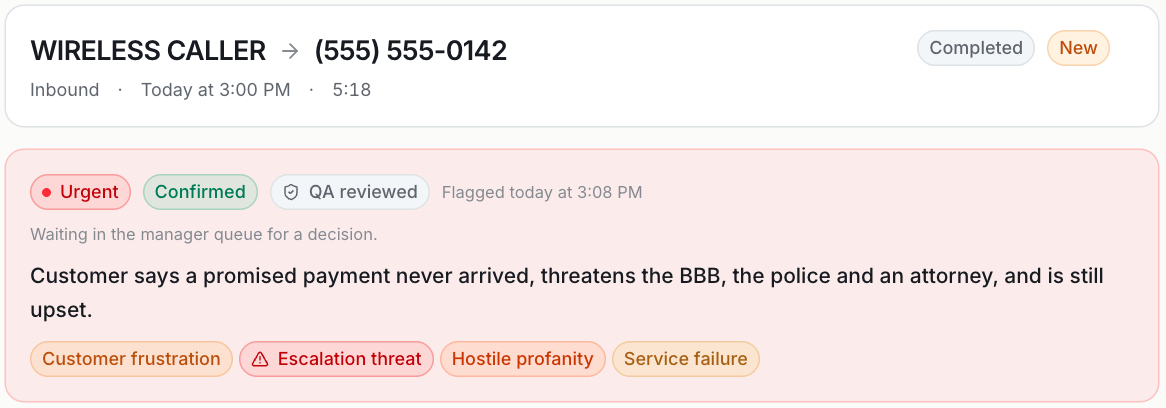
The call started at 3:00 PM. At 3:08 PM the AI had read it and flagged it red: Customer says a promised payment never arrived, threatens the BBB, the police and an attorney, and is still upset. A second, stronger AI double-checked it and confirmed. Urgent. Escalation threat.
Urgent flags go straight to the owner’s phone as a text: the reason, that one line and a link to the call. That is what happened here.
The employee did what most people do. Nobody yelled back, the caller was told it was out of their hands, and the call ended with a thank you. By a politeness score that is a clean call. That is exactly why nobody would ever have caught it.
And the one that happened while the truck was still moving
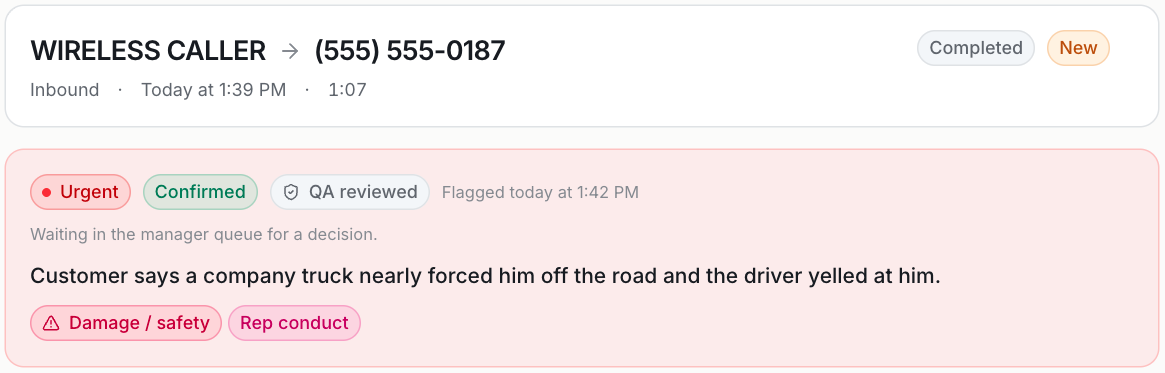
1:39 PM, another day. A man called from his car. One of the trucks had nearly run him off the road, he said, and the driver had yelled at him out the window. The rep said they would tell a manager.
1:42 PM. The owner’s phone buzzed. One line: Customer says a company truck nearly forced him off the road and the driver yelled at him. Three minutes. He heard it while it was still a phone call, not a review.
Where the time and the money went
Nobody listens harder now. Something reads everything.
- It reads every call minutes after it ends. No pile, no backlog, no Friday review.
- A cheap AI reads all of them. A stronger AI double-checks only the few it flags. About 4 calls in 100 get flagged and the second AI removes about a third of those. What is left, about 100 calls a month, reaches the owner.
- Each call is one plain line, the exact words, and a play button. About an hour of reading instead of 200 hours of listening.
- It costs about a third of a cent a call. The AI that reads them is about $14 a month.


Faster than any person. Smarter than any QA software.
Better than a person. Nobody can hear 4,000 calls. A person samples ten and hears them on Friday. This AI reads every call minutes after it ends, and call 4,000 gets the same attention as call 1. It does not get tired, it does not skip the long ones, and it does not have a favorite employee.
Smarter than general QA software. Call-scoring software typically grades every business the same way: a greeting, a tone score, talk time, a mood graph. The employee on the attorney call stayed civil and closed with a “you’re welcome.” A politeness score gives that call full marks. The word “attorney” was in there the whole time, and it has no idea that is an emergency in your business.
This AI is trained on your business. It is taught how your business works and what your rules are:
- How it runs: your services, your service area, your prices, who handles what.
- Your terms and conditions: refunds, cancellations, payment terms, what a rep may promise and what they must never promise.
- Your rules: what counts as urgent, when the owner must be pulled in on the spot, when a customer must hear back.
- Your people: who gets the text, for which kind of call, at what hour.
- Your red flags: the words that mean a customer is about to leave or call a lawyer.
So it can tell a rep who gave a customer wrong information from one who didn’t, a big job (“I need 50 trucks”) left in a message from one the owner heard about right away, and a customer who is just annoyed from one who is about to hire an attorney. Software that has never read your rules cannot. When the AI flags something wrong, the owner says so and it gets tighter.
What it changes for you
If you run the business: you stop finding out last. You do not have to listen to anything, and you do not have to wonder what was said.
If you pay a manager to review calls: ask what they heard last month. Then compare it with 100 flagged calls and $14.
The result
$14 a month
for an AI to read every one of 4,000 calls
| Before | After | |
|---|---|---|
| Calls anyone hears | A handful, usually the angry ones | All 4,000 are read |
| When the owner finds out | Friday, from a lawyer | Minutes after the call |
| Hours of listening | 200, so nobody does it | About an hour of reading |
| What it costs | $4,000 a month for a person, if you ever hired one | About $14 for the AI that reads them |
The AI does not answer the phone, send the check or call the customer back. It makes sure you hear first.
Steal this
Want to build this yourself? Here's how it was built, in plain words. It works with any phone system that records calls.
| The piece | What it does |
|---|---|
| Your phone system (RingCentral here) | Records every call and hands over the recording |
| pyannote | Turns each recording into text and tells your team from the customer |
| AI models from OpenAI | A fast, cheap one reads every call. A stronger one double-checks only the calls it flags. That is how the cost stays low |
| Twilio | Texts the owner when a call is flagged |
| Resend | Emails the summary |
| Hosting | Keeps it running behind a login |
| Claude Code | Builds it and keeps it running |
The hardest part is teaching it your rules: what counts as urgent, what a rep may promise, and who gets the text at 9 PM.
Prefer not to build it? Have us do it for you.
Is your business in the same spot?
In 30 minutes we'll look at your version of this problem and how an AI system could handle it for you.
Book a 30-minute consult, $99